
As a startup, you need one of the best people to join your team and make your growth curve as steep as possible. One of the biggest challenges, is to retain them: once they do join you.
The seeds are sown at the induction stage.
I am going to focus on the high performers your firm manages to recruit for top positions. These individuals have joined you, because they are "different". It's their individuality which separates from the crowd.It's this trait, which made you hunt for them, and empower your team with their presence.
However, this is where the first seed of failure is sown. Their induction in the firm is dealt with a standard SOP at best, and a very casual team introduction at its worst.
You ignored the most important factor when it comes to these assets: Their Individuality

Let us take a case study approach:
Meet Sam Paul. Enterprenuer who made record growth in first two years of his fashion startup and has just secured a $10 million funding. He is a star eyed boy of all the VC's in the scene.
Truth be told: the expectations are overwhelming. The growth has been so quick that multitasking skills have now boredered over chaos management. Before it takes the form of firefighting, Sam needs to hire a VP.

Meet Maya: Batchmate of Sam. Consultant with one of the biggest firms, a ninja at problem solving. Maya and Sam were together in the olympiad team, he knows her skills are exactly what he needs, Maya has realized that the stress in the stifling enviornment, without a chance to lead and no recognition is not her cup of tea. She gladly accepts Sam's offer, which is 50% of what she currently earns.

Nice story right? Do they work happily ever after? : No
let us break down the problem:
When the firm hires, following two factors matter the most
- Core strengths of the hire.
- Ability to learn new skills, and execute them across departments other then the hire's own department
When a high achiever walks in, the expectations which are carried inside are
- Do I get to make a difference with my core skills? Do I get to do my thing, in peace?
- How much do I learn? What will my learning curve be like?
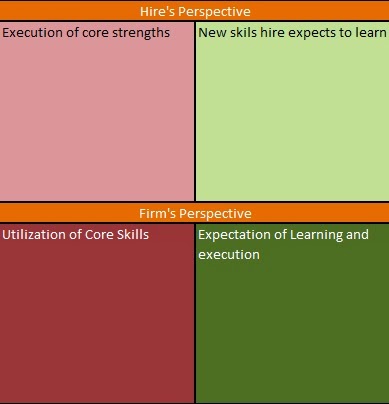
There are some additional factors too, which make a major impact
Team work: How much does the hire look forward towards working in teams? How important is it for the firm to have the new hire fit into the teams and gel with them?
Social Expectations: Does the new hire come from an enviornment where office parties were more of a norm than exception. Or does she come from an extremely comprtitve and a serious setup where a distance between employees was not only expected by encouraged.Is office get otgether and a firendly enviornment a black swan , uncomfortable event for this hire?
What is the firm's stand on this?
Now let us come to Maya and Sam
Maya expects that she will be given independence to go all out in her work. She will work at her pace, without the worries of a team not being able to catch up, away from the politics of a group she detested.Her past experience makes her crave independence and solitude.
She is NOT looking forward towards learning and executing skills completely unknown to her. She is an achievement oriented person who wants to excel and rise in her core skill area. She has had enough parties that she could puke at the mere idea of an office party!!
(No pun intended)
Sam needs a VP. Someone who is so comfortable in her core area that she will gladly handle other strings which are loose. he wants a team player who leads by example. He thinks the teams need to hang out more to develop camaraderie
A clear mismatch, right?
we need to analyse this better, we need to SEE the problem.
Lets try: we rate the priority out of 10
| Hire | Firm | |
| Using core strengths | 7 | 4 |
| Learning New skils | 3 | 6 |
| Team Work | 4 | 7 |
| Multitasking | 4 | 7 |
| Social Aspects | 2 | 6 |
So here is what we get

Red represents the Firm, our Sam.Blue is Maya, the Diva Hire
The above graph shows obvious mismatch between "expectations".This is probably the most important thing to notice. Expectations can be aligned, provided one knows exactly where the alignment needs to be done, and for How Long
Above picture gives an idea of an obvious mismatch. To analyse it deeper, we could use a radar graph.

HR and the management needs to sit down and close the gap with the new hire.
This exercise, if done at induction stage: will work wonders. A win win situation is always a necessary condition for miraculous results to happen.


